A common criticism of painting, and of figurative painting in particular, is that it is all too instantaneous. Narratives necessarily require the passage of time, or at least, the semblance of it; hence, film, theatre, and literature all work via the compounding of experience, to the point of emotional culmination. When a painter attempts to invoke that same passage of time, however, their effort seems – to the contemporary eye – puerile. Photography evades this criticism in that it is instantaneous by nature, and does not aspire to be otherwise; even the narrative inclinations of the Vancouver School are always bracketed within reference to the history of painting, and in that sense, are latter day paintings themselves.
This is why the work of British painter Jenny Saville is all the more provocative. Saville is pre-eminently recognized for her neo-feminist sundering of gender identities, her brutal, glutinous reification of human and animal form, and the overwhelming scale of her subjects; but less appreciated are her efforts to prevent the instantaneous perception of her painting. Nowhere are these efforts more apparent than in her latest exhibition, Oxyrhynchus, at the Gagosian Britannia in London.
Under the auspices of no less than five security guards, the latest in Saville’s prodigious output managed to hold its own against the cavernous space of the Gagosian. The result of several years of work, Oxyrhynchus takes its name from the ancient Egyptian rubbish dump of the same name, which has served as a potent source of artefacts for historians ever since it was first excavated in the late 19th century. Though the relation between the name and the work feels contrived – it is always tempting for artists to name their exhibitions after subjects of antiquity – there is a sense in which, just as the discarded detritus of time often comes to serve as the basis for its revitalization, so too do the immediate abstractions and careless brushstrokes of Saville’s paintings form a greater cohesiveness within them.
It is this cohesiveness which lies at the heart of that criticism mentioned above – that instantaneity. But crucially, for Saville, this cohesiveness is always delayed. One looks at a Saville painting and works to identify figures. They are always there, in the end, but they are obscured by their own posturing and self-awareness. They refuse to stay still, instead collapsing into a myriad of elements: arms, legs, breasts, hands and faces extrude, endlessly attempting to escape the form of the body, but always falling back into the mass of the body itself, which becomes gargantuan and all-encompassing in its many-faced repose.
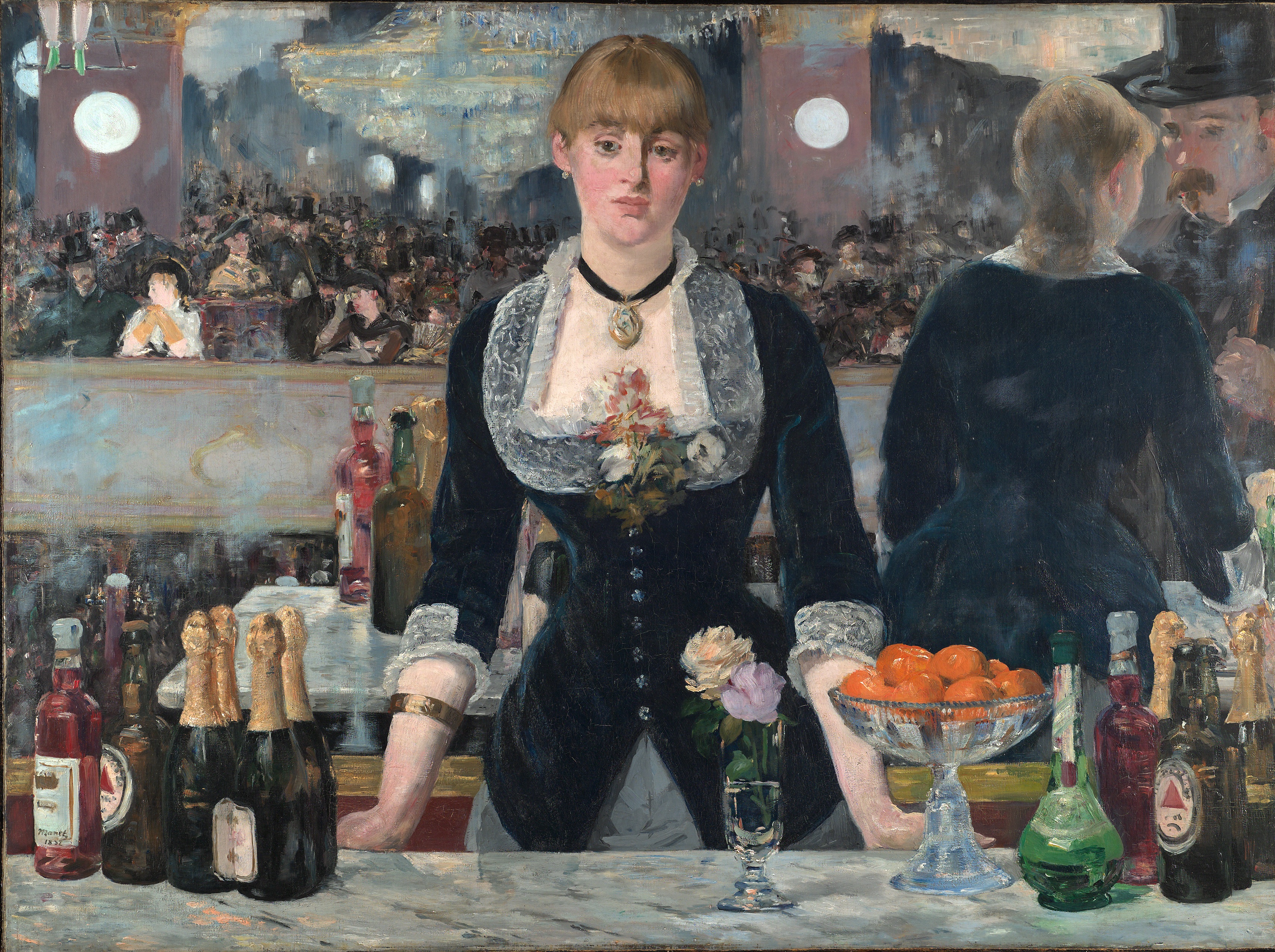
Un bar aux Folies Bergère
(detail)
The extended life of Saville’s work demonstrates itself well in one of the exhibition’s central works, Odalisque. One observes a multi-racial couple – possibly the artist and her partner, though this is unclear – lying together in front of a mirror. Though occupying a seemingly linear three-dimensional space, the couple’s repose is interrupted by its own hybridity. The man rests his left leg under the woman, while he gazes down upon her; yet, simultaneously, one observes him lying next to himself, this time pulling his partner’s distended leg over his chest, as if engaged in a ludic wrestling match. Crucially, the mirror reflects an oppositional composition, echoing Manet’s Bar at the Folies-Bergere - the woman, her back turned to the viewer, supports herself upright while the man reclines.
It is the paradoxical nature of the composition which prevents the instantaneity of the painting. Rather than baulking at the monstrosity of the human form, as in the work of Willem de Kooning (to whom much of Oxyrhynchus owes itself in its messiness), Saville treats it with a degree of tenderness. Yet she is uncomfortable with allowing it to abide; rather, one experiences the form via a passage of indistinct visual gestures, variously realized in lurid oil and brash charcoal meanderings, which concatenate into an imperfect whole. The sense in which this passage of gestures must be experienced as a passage of time is compounded by the size of the painting – one must physically walk along it to appreciate it in its entirety.
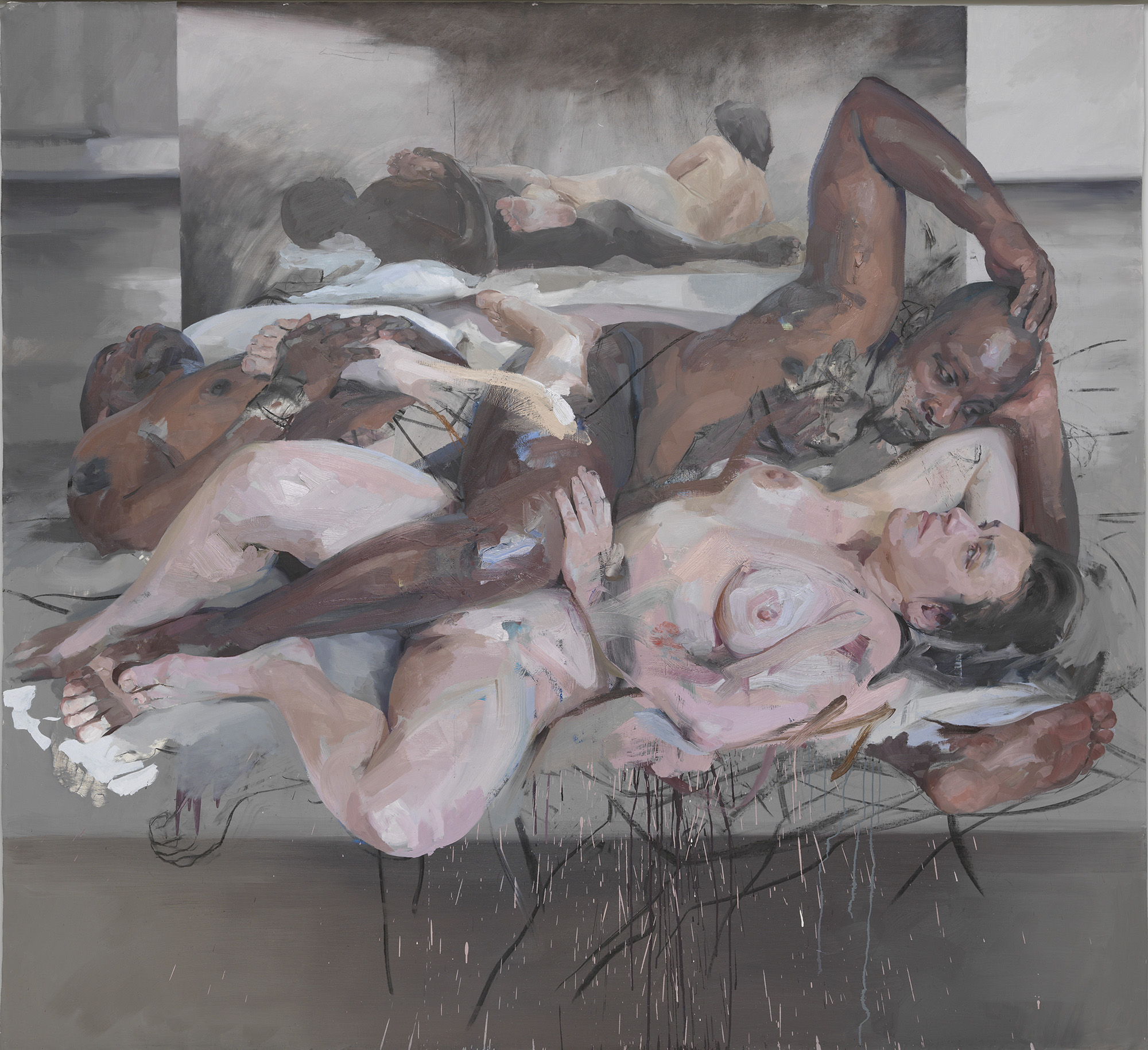
Odalisque, 2012 – 2014.
Oil and charcoal on canvas.
(detail)
Thus, Saville evades the threat of immediacy. She is, of course, not the first painter to do so – her work is indebted largely to the legacy of Francis Bacon – but while others struggle to reconcile the differences between abstraction and figuration, Saville masterfully employs each to serve the purpose of the other.